
Standard paint gives you a colour. Specialty finishes give you character. The difference is depth, texture, and how light behaves on the surface. A glazed door catches shadow along every profile edge. A metallic surface shifts tone as you walk past it. One flat coat cannot do that.
What Makes a Finish "Specialty"
Specialty finishes are multi-layer decorative treatments. They go well beyond a single colour.
Most involve three elements:
- A base coat establishing the underlying colour
- A decorative layer such as glaze, texture, or metallic
- A protective topcoat sealing everything underneath
Each layer is applied by spray or by hand. Timing and technique control the final result.
Standard painting uses two or three coats. Specialty work often uses five or six.
The Four Main Finish Types
ed finishes. A tinted glaze is applied then wiped back. It settles into profiles, corners, and detailing. This creates shadow and visual depth. Best suited to raised-panel and traditional doors.
Distressed finishes. Edges and corners are deliberately worn. The result reads as aged and lived-in. Popular in farmhouse and cottage kitchens.
Metallic finishes. Bronze, gold, pewter, or champagne tones. Usually applied subtly rather than boldly. Works particularly well on islands and accent cabinetry.
High-gloss lacquer. Multiple sprayed and levelled coats. Delivers a sleek, reflective, contemporary surface. Demands flawless preparation underneath.
Prefer something simpler? Standard cabinet painting may suit your kitchen better.
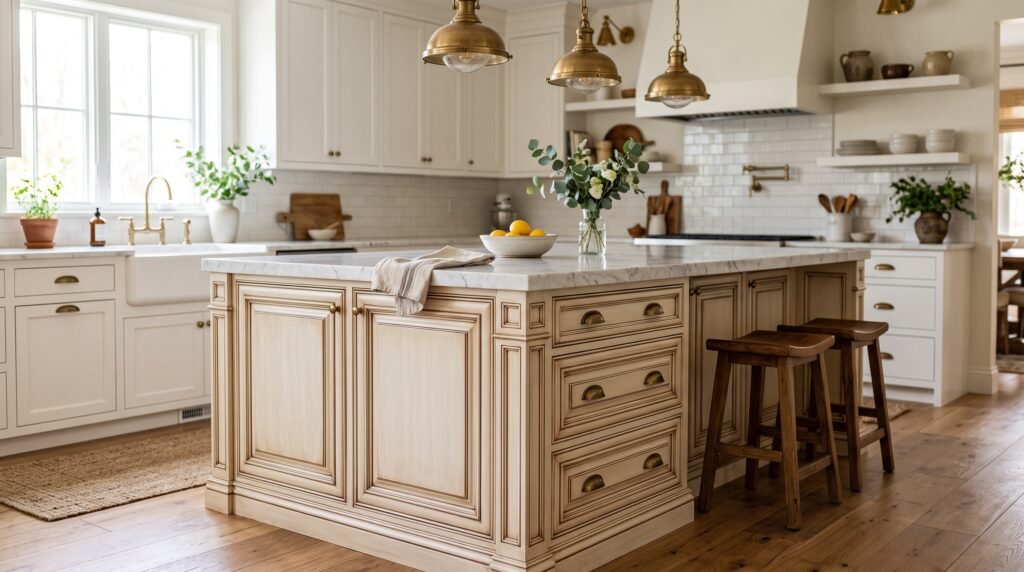
Comparing Specialty Finishes
Each option suits a different style of home.
| Finish | Best Door Style | Style Match | Maintenance |
|---|---|---|---|
| Glazed | Raised panel | Traditional, transitional | Easy |
| Distressed | Shaker, beadboard | Farmhouse, cottage | Very easy |
| Metallic | Flat panel, shaker | Modern, glamorous | Moderate |
| High gloss | Flat panel | Contemporary, minimalist | Shows fingerprints |
High gloss looks stunning on flat doors. It exposes every imperfection on detailed ones.
Why Samples Always Come First
Never approve a specialty finish from a photograph. Lighting changes the result completely.
Our process protects you from surprises.
- Sample made. A physical sample is created on your actual door material.
- Seen in your light. You review it in your own kitchen lighting.
- Adjusted if needed. Glaze depth or metallic intensity is tuned.
- Applied in full. Work begins only after you approve the sample.
Homes across the Triangle vary enormously in natural light. A finish that glows in a south-facing room can look flat elsewhere.
We follow this process for Specialty Finishes Services in Chapel Hill, NC every time.
The same approach applies to Specialty Finishes Services in Youngsville, NC projects.
Where Specialty Finishes Work Best
These treatments suit focal points more than entire kitchens.
- Kitchen islands as a deliberate contrast to perimeter cabinets
- Butler’s pantries where a richer look feels appropriate
- Bathroom vanities as a single statement piece
- Built-in bookcases and display cabinetry
- Range hoods and decorative wood surrounds
- Wet bars and entertaining areas
Many clients apply specialty work to one area only. The rest stays deliberately simple.
That contrast is what makes the feature read as intentional.
Combining Finishes Across a Home
Consistency matters when finishes are distinctive.
A kitchen cabinet finish should relate to nearby rooms.
The same tone often carries beautifully into Bathroom Cabinet Services in Youngsville, NC projects.
If your door style needs updating too, consider cabinet refacing alongside the finish.
For solid wood you want to preserve, cabinet refinishing may be the better base.
Completed specialty work is visible in our gallery.
What to Expect During the Project
Specialty finishes take longer than standard painting. The extra time is in the layers.
- Sample rounds happen before any work begins
- Each layer must cure before the next is applied
- Hand-worked stages cannot be rushed
- Topcoat curing determines final durability
Most projects run five to ten days. Complex multi-layer work sits at the longer end.
Hand-applied finishes carry slight natural variation between doors. That variation is the character, not a defect.
Learn about our craftsmanship on our about page.
Ready to discuss ideas? Book a free consultation or call 919 740 6347.
Frequently Asked Questions
Multi-layer decorative treatments using glaze, texture, metallic, or high-gloss techniques beyond standard paint.
Most projects run five to ten days, depending on the number of layers involved.
Yes. A protective topcoat seals every decorative layer underneath.
Usually yes. Bring a photograph and a physical sample is created for approval.